Skip to content

In memory of

Stig Lundbäck

1945–2017

Physician, researcher, inventor and father. His curiosity about how the heart works took him from the examination room to the prototype workshop and out to sea.

Black-and-white portrait of Stig Lundbäck smiling and wearing glasses
Stig Lundbäck · Lundbäck Legacy

About Stig

Dad in the prototype workshop

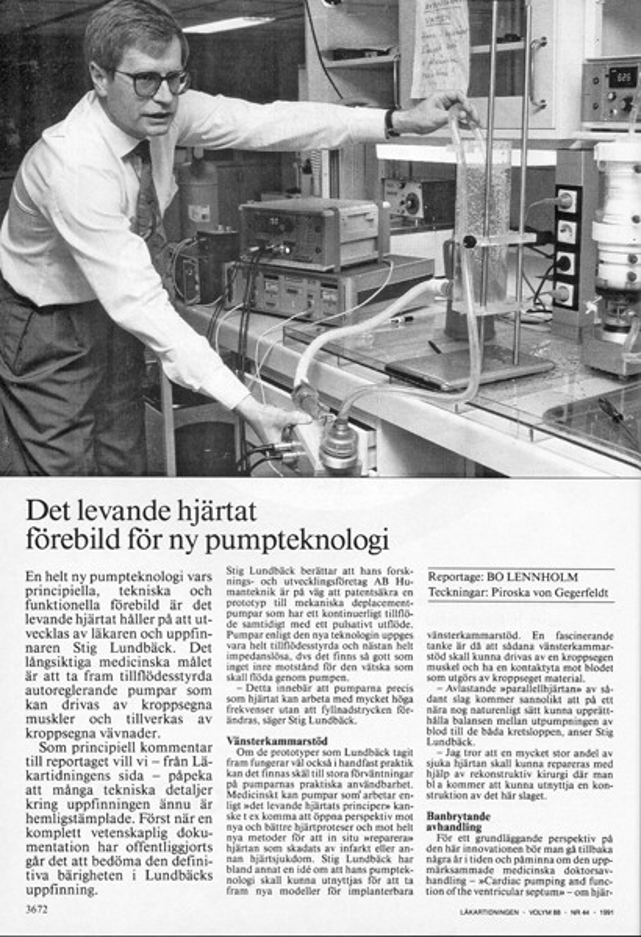
Stig demonstrating his pump modelRead the Läkartidningen report

Stig started building and testing his own inventions long before he qualified as a doctor. As a boy he built his own three-stage rockets. As a young man he began studying nuclear physics before choosing medicine.

As a clinical physiologist at Södersjukhuset in Stockholm, he brought his interest in physics and mechanics to his work with patients. Examining hearts with ultrasound, he began to wonder what the images really showed. He took the question of how the heart pumps back to the workshop, where he could put his ideas to the test in models and prototypes.

“I’d rather have a steam engine in the middle of the floor than a Rembrandt on the wall.”
Stig Lundbäck on his love of engineering, from his notes (translated from Swedish)

Family recordings · 2017

Stig remembers how he came to build a pump

On 27 May 2017, Stig recorded his memories of working on the heart. He began with a question that had stayed with him since his years at Södersjukhuset. How much could you really learn from seeing the heart move in an image?

Patients and the first questions

A question in the ultrasound room

In the late 1970s, Stig examined patients before heart surgery. In some who were seriously ill, the heart’s outer contour appeared to move vigorously. When he used that movement to calculate how much blood the heart pumped, the figures seemed implausibly high. He began tracking the wall between the ventricles on ultrasound and comparing his calculations with measurements from cardiac catheterisation. Looking back, he saw those comparisons as the beginning of his thesis.

In his lectures, Stig took the examination methods one at a time. He used the word “illusions” to describe how someone who expected the heart to squeeze with each beat could look at an image and see just that. He wanted his audience to look again and ask what was actually moving.

From Stig’s recording Hjärtats mekanik nr 2 (The mechanics of the heart, part 2), approximately 4:38–5:29.

When his colleagues began asking Stig

On ultrasound, Stig saw the wall between the ventricles bow to one side and then move back. It reminded him of a diaphragm pump. He tried to calculate how much blood the movement of the wall helped to eject and compared his figures with measurements from cardiac catheterisation. After a year or so in the group, he recalled, colleagues began asking him how much blood was leaking back through a patient’s faulty valve.

From Stig’s recording Hjärtats mekanik nr 2 (The Mechanics of the Heart, no. 2), approximately 3:15–4:20.

The competitive cyclist with aortic regurgitation

The cyclist sought help for an uncomfortable feeling in his chest, especially at rest. Stig remembered how the man walked up and down the stairs at home because he felt so unwell when he lay down. His ECG was unremarkable, and Stig heard nothing unusual through the stethoscope.

In his thesis, Stig describes the exercise test on the hospital bike. The workload rose by 50 watts every five minutes. The cyclist reached 450 watts and pedalled at that load for two minutes. Stig remembered the smell of scorched dust from the bike spreading through the ward.

Stig recalled that the senior physician found it hard to believe someone who could cycle that well had a heart problem. Yet when the cyclist lay down, Stig saw on ultrasound that the wall between the ventricles swung unusually far back and forth. He suspected severe aortic regurgitation, a leak that lets blood flow back from the aorta into the left ventricle. Stig recalled that the cyclist went on to ride Vätternrundan, the Swedish long-distance cycling event, and described him as having won it.

The symptoms persisted. In the thesis, Stig writes that cardiac catheterisation revealed that two of the three aortic valve leaflets had ruptured completely. As the heart relaxed between beats, the pressure in the aorta and the left ventricle was almost the same. The cyclist received an artificial aortic valve, and his racing career ended.

Stig remembered a morning phone call from Karolinska. The team who had examined the cyclist wanted to know how he had been able to tell that the leak was so severe. Afterwards, his senior colleague encouraged him to pursue his thesis.

Why did the cyclist feel worse at rest when he could pedal so hard? In his pump model, Stig proposed that when inflow and heart rate were high, the blood’s momentum kept it moving forwards between beats. At rest, the longer interval between beats gave blood more time to leak back through the damaged valve. This was how he explained the difference between the exercise test and the cyclist’s symptoms at home.

Read the case in the thesis (PDF), section 11.11, pp. 101–102, patient 1.

From Stig’s recording Hjärta del 3 (Heart, part 3), 27 May 2017, approximately 1:11–4:53. Stig mentions the ride at 3:35. He recalls the examination and the phone call at approximately 4:09–4:53.

The patient who passed the exercise test

Stig remembered another patient who came for a fitness test. The man managed a normal workload on the exercise bike. Yet when Stig examined him with ultrasound, he saw that parts of the left ventricle were moving abnormally. The man said he had been ill for a time but had been able to return to his physically demanding job.

Stig recalled that on a later scan using scintigraphy, the wall between the ventricles stood out as the part that still seemed to work well. He linked that encounter to a question he went on to explore with a mechanical model. Could the part that still worked be put to use to help a damaged heart?

From Stig’s recording Hjärta del 3 (Heart, part 3), approximately 4:53–7:17.

Back to the stories index ↑

The workshop and the experiments

Before the heart pump, they built a device to study the kidneys

When Stig studied how the kidneys excreted a tracer, he wondered how much the position of the kidneys in the body affected the measurement itself. He recalled receiving 300,000 Swedish kronor from the county council to investigate. Together with the hospital’s medical technicians, he built equipment that could take measurements from different directions. He remembered seeing that the position of the kidneys really did change the shape of the curves. When it was time to build his first heart pump, he turned to the same technicians.

From Stig’s recording Hjärta 4 (Heart 4), approximately 0:19–2:50.

A circulatory system in a suitcase

Stig and the technicians built a pump and a model with two circuits, one for the lungs and one for the rest of the body.

Stig remembered a call from Astra’s head of patents, who had heard the pump worked and wanted to tell the company’s management. Five days later, the management team came to see the circulatory system in action. One of the visitors was the cardiologist Lars Werkö. Stig remembered Werkö watching the model at work and saying that it helped him understand both how blood pressure is regulated and the Frank–Starling relationship between how much the heart fills and how much blood it pumps out on the next beat. Stig even remembered the days of the week. The visit was on a Monday, and by Thursday he and Astra had signed an agreement.

From Stig’s recording Hjärta 4 (Heart 4), 27 May 2017, approximately 3:36–5:04. Stig recalls Werkö’s reaction at approximately 4:11–4:46.

When Stig moved to Astra Tech, the engineer Jonas Johnson was among those who joined him. As work on the artificial heart gathered pace, Stig compiled the tables for his thesis.

Stig recalled that patent engineers doubted a pump could take in liquid continuously while sending it out in pulses, as the heart does. To show them how it worked, the team fitted a working circulatory system, complete with pump and electronics, into a suitcase.

The suitcase allowed Stig and his colleagues to travel the world and demonstrate the pump to patent engineers. They could see for themselves that liquid kept flowing in between pulses on the outlet side. Stig remembered those demonstrations as an important step towards the patent.

From Stig’s recording Ny inspelning 7 (New recording 7), 27 May 2017, approximately 1:47–2:44.

The unpublished experiments at Ultuna

At Ultuna in Uppsala in the 1980s, the group tested its artificial heart pumps in calves. Stig recalled how they first took measurements while a calf’s own heart was beating. After replacing the heart with their pumps, they repeated the measurements. As he remembered it, the results were similar.

When he recorded this account in 2017, Stig said the records still existed. In his recollection, the experiments had been kept confidential during development and the results had never been published. He remembered the artificial heart work coming to an end after a change in leadership at Astra.

From Stig’s recording Hjärtats mekanik nr 1 (The Mechanics of the Heart, no. 1), approximately 13:03–14:47.

The heartbeat on film

Ahead of his thesis defence in 1986, Stig made animated films in Swedish and English to show how he pictured the heart moving inside the chest. A thought experiment helped inspire the films. The heart lies just behind the breastbone. If its outline changed as much as the images seemed to show, what would happen to everything around it? Stig reasoned that you ought to see the breastbone move back and forth with every beat.

From Stig’s recording Hjärtats mekanik nr 1 (The mechanics of the heart, part 1), approximately 3:51–5:16.

Later in the 1980s he gained access to a high-speed camera. With it he could study the heart’s outline frame by frame and compare what he saw when the sac surrounding the heart was closed and when it was opened.

In a recording in June 2017, Stig returned to those films and examinations. He wanted the results from his thesis years onwards to be brought together so others could trace how he arrived at his model.

Explore Stig’s model of how the heart pumps

Back to the stories index ↑

The thesis and Stig’s reflections

When Stig himself fell ill

During his years at Södersjukhuset, Stig became seriously ill. In the recording he recalls the decision he made then. He wanted to press on with his thesis. He continued working as a clinical physiologist during treatment. It was in those years that he met several of the patients he would later remember in these recordings.

From Stig’s recording Hjärta del 3 (Heart, part 3), approximately 0:19–0:55.

The floppy disk and the thesis defence

Stig wanted to know what others had already written about how the heart pumps. He had help reading papers in Russian, Spanish and French. His thesis went to England and the United States for proofreading. Two days before the defence, it was due to be printed in Stockholm. Stig recalled that an early floppy disk ended up in the computer. Errors reappeared in the printed book, in both the text and the figures.

The examiner had made notes while reading, and Stig was later able to use them to correct the text.

From Stig’s recording Ny inspelning 7 (New recording 7), 27 May 2017, approximately 2:44–5:11.

What happens during a paradigm shift?

Stig remembered the examiner giving him a book about what happens when an established way of thinking starts to change. The examiner believed Stig’s work would lead to a paradigm shift, but that it might take forty or fifty years. At the time that seemed far too long to Stig. By the time he recounted the conversation in 2017, he had changed his mind.

At first, nothing happens, Stig said. Then people start looking through their own drawers. Had they already done something similar that they could write up? Eventually, he felt, others might even steal what someone had written and credit somebody else with the original discovery. Stig said he thought he was beginning to see that happen with his own work.

From Stig’s recording Ny inspelning 7 (New recording 7), 27 May 2017, approximately 5:11–6:08.

The heart when we run, laugh or grieve

In the middle of explaining pistons and stroke volumes, Stig turns to everyday life. We lie on our side, go for a run, enjoy ourselves or grieve. Whatever we are doing, the two sides of the heart have to keep pace with each other. This was what fascinated him about a healthy heart. In his model, each side adapts to the blood returning to it. He wanted his mechanical pump to do the same.

From Stig’s recording Hjärtats mekanik nr 1 (The Mechanics of the Heart, no. 1), approximately 12:01–12:53.

Back to the stories index ↑

Research and inventions

From heartbeats to ocean waves

Stig studied the movement of the valve plane between the atria and ventricles and the role of the wall separating the two ventricles. The model he described in 1986 became the basis of a heart-inspired pumping principle he called the Dynamic Adaptive Piston Pump (DAPP).

How DAPP and the ventricular septum work in Stig’s model

Stig beside his pump model
Stig beside his pump model · Läkartidningen

The double pump

Artificial hearts

At Astra Tech, Stig developed a double pump to mimic the work of both ventricles. It was designed to drive circulation through the lungs and the rest of the body. He also worked on pumps to support a failing heart.

Read the double-pump patent
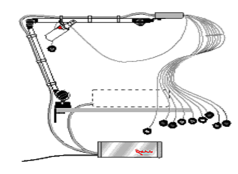
Support arm with tubing and suction electrodes for ECG

Quickels

Vacuum electrodes

Stig developed ECG electrodes held against the skin by suction. He refined their seals and the way they handled moisture. The vacuum technology was carried forward in the Quickels ECG system.

Read the vacuum electrode patent
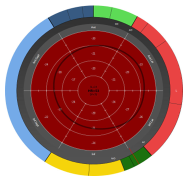
GrippingHeart’s circular diagram of the phases of the cardiac cycle

GrippingHeart

Mapping the phases of a heartbeat

Working with KTH Royal Institute of Technology, GrippingHeart developed the Cardiac State Diagram to show when mechanical events occur during a heartbeat. Measurements can be displayed on a circular diagram to make the phases of the cardiac cycle easier to compare.

Read about the Cardiac State Diagram at KTH
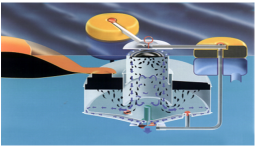
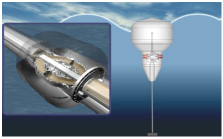
Cutaway of the separator at the water surface

Water treatment

Surfcleaner

In the workshop, Stig and his colleagues built prototypes to collect floating pollutants. Surfcleaner drew on the pumping principle to separate substances such as oil from water at the surface.

Surfcleaner on its origins
Wave energy buoy and a detail of its drivetrain

Wave power

CorPower Ocean

The rhythmic work of the heart also inspired Stig’s work on wave energy. He developed the early technology with Patrik Möller. CorPower Ocean dates its founding to 2012 and develops devices that turn the motion of waves into electricity.

The development of CorPower Ocean
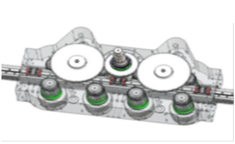
Toothed rack between the gears of the cascade gearbox

Cascade Drives

Cascade drive – from linear motion to rotation

Stig, Patrik Möller and their colleagues developed a cascade gearbox that transmits the linear motion of a toothed rack to a rotating shaft. The design grew out of their work on the wave energy drivetrain and was later developed for industrial linear drives.

Read the cascade gearbox patent

DAPP and the ventricular septum

How can the heart receive blood while pumping it out? And how do its right and left sides keep pace with each other? Stig looked for answers in the movement of the valve plane and in the muscular wall the ventricles share.

Explore the measurements and pump experiment in the thesis · Watch Stig’s films about the heart and DAPP

A pump that adapts to inflow

The valve plane is the region containing the valves between the atria and the ventricles. When the ventricles contract, this plane moves towards the tip of the heart, or apex, much like a piston. The ventricles eject blood into the arteries. The same movement creates space in the atria, allowing blood from the veins to flow in while the ventricles are still emptying.

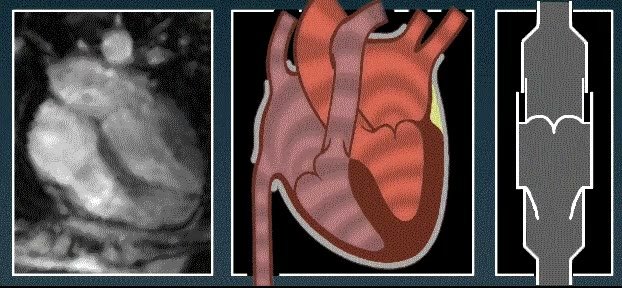
A cardiac image, a drawing of the heart and the pump piston in the same frame.
Watch the heart, the heart model and the pump piston side by side
Back to the topic index ↑

The wall that helps balance the ventricles

The right ventricle pumps blood to the lungs. From there, blood flows to the left side of the heart and is pumped out to the body. Over time, roughly the same volume must pass through both circuits. In his thesis, Stig described how the ventricular septum, the muscular wall between the ventricles, might help maintain that balance.

The wall is yielding as the ventricles fill. If filling pressure rises on the right in relation to the left, the wall can shift to the left. This gives the right ventricle more room and the left less.

When the muscle contracts, the wall tends to return to the shape it takes during contraction. In Stig’s model, the right ventricle can then eject more blood on that beat and the left less. A pressure change during filling can thus alter the stroke volume of both ventricles. He described this mechanical feedback as autoregulation.

Stig’s thesis on cardiac pumping and the ventricular septum (1986) on PubMed

Download Stig’s thesis (PDF, 2.7 MB)

Back to the topic index ↑

Why Stig described DAPP as a new type of pump

In the recording, Stig uses a hand-operated garden pump as his example. Each time you move the handle, the piston moves a portion of water. How far and how often you work the handle affects how much water you draw. In his book manuscript he also compares it with a centrifugal pump, where a spinning impeller sets the liquid in motion. The speed of the impeller affects both pressure and flow.

Stig wanted to build a pump whose stroke length could change in response to the water flowing into it. The two faces of the piston in his ΔV pump have different effective areas. When the driving force is released, the incoming liquid moves the piston back. If more liquid flows in, the piston can travel further back and deliver a larger volume on the next stroke.

Inflow can continue even as liquid leaves the pump in pulses. This combination of properties led Stig to describe the ΔV pump as a new type of piston pump. He called the technology the Dynamic Adaptive Piston Pump (DAPP).

Stig compares pumps in the family recording Hjärtats mekanik nr 1 (The Mechanics of the Heart, no. 1), approximately 5:32–7:36 and 10:12–12:16. He describes the centrifugal pump in his GrippingHeart book manuscript.

Laboratory study of the pump’s response to increased inflow (1991)

Back to the topic index ↑

The heart’s resilient suspension

In a family recording, Stig describes the moment when the ventricles finish emptying and begin to fill again. As the valve plane is pulled towards the apex, tension develops where the sac surrounding the heart attaches to the diaphragm. The attachment can give a little. Stig called this movement and the force opposing it the heart’s resilient suspension.

In the recording, Stig follows the moving blood through this change of direction. As the heart muscle relaxes, tension in the suspension eases, but blood keeps flowing in towards the apex. In his model, the kinetic energy of that blood helps both the valve plane and the heart as a whole return towards their starting positions. Inflow can therefore continue even while the valve plane reverses direction.

From Stig’s recording Hjärtats mekanik nr 1 (The Mechanics of the Heart, no. 1), 27 May 2017, approximately 23:01–24:25. He also describes the suspension in the patent text A Cardiac State System, pp. 23–24.

Back to the topic index ↑

The twisting heart and the idea behind the gearboxes

When Stig studied a heartbeat, he followed both the movement of the valve plane towards the apex and the twisting of the heart. In his manuscript, he distinguishes torsion within the heart muscle, where different parts twist relative to one another, from rotation of the whole heart about its long axis. In his model, this rotation can reduce stretching of the aorta and pulmonary artery, making it easier for the valve plane to move.

In our family, we remember Dad carrying the idea of the heart’s twisting motion into his work on gearboxes. He drew on it both when he and Patrik Möller developed the cascade gearbox for wave power and when he worked on the planetary gearbox. In the cascade gearbox, the straight-line motion of a toothed rack turns a shaft. In the planetary gearbox, several gears share the torque.

See the cascade gearbox · See the planetary gearbox

Stig describes the twisting motion in chapter 5 of his book manuscript (version 9) and in the patent text A Cardiac State System, pp. 9 and 23.

Back to the topic index ↑

Stig’s presentation · 12 February 2016

Four ways the eye can misread a heartbeat

Our family remembers Stig showing what he called the four “illusions” of the heartbeat. A ventricle can seem to squeeze inward when you follow its inner edge. What happens if you watch the outside of the heart or the plane of the valves during the same beat? In his lectures, Stig used these images to show how different the same heartbeat can look depending on which part of the heart you follow.

The short clips repeat once you start them. You can pause to compare individual frames.

Contrast X-ray – follow two outlines

First follow the inner outline, where the contrast dye shows the ventricular cavity. Then watch the outer edge of the heart during the same beat. Stig pointed out how much further the inner outline moves.

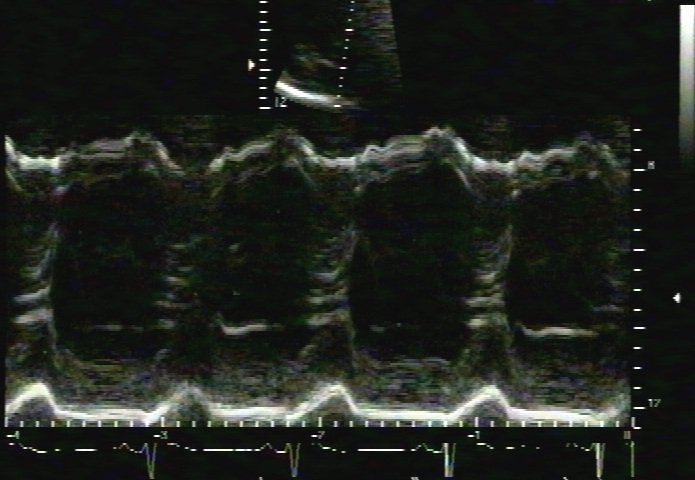
M-mode – a heartbeat along a single line

Read the ultrasound trace from left to right. Each bright line tracks the changing distance to a tissue boundary along the ultrasound beam. Stig used this image to ask how much a measurement along one line can tell us about the movement of the whole heart.

An M-mode ultrasound trace with bright tissue boundaries tracked across several heartbeats.

Open-chest surgery – the support of the pericardium

Stig showed two high-speed films taken during open-chest surgery. In the first, the sac surrounding the heart, the pericardium, is closed. In the second it has been opened. The ruler in view gives a fixed reference for following the movement of the heart’s outer contour. In his interpretation, support from the sac and surrounding tissues affected how the heartbeat looked.

The heart wall – follow the inner edge

The wall appears thicker as the ventricle empties. Watch the inner surface during one beat, then follow the plane of the valves during the next. In his model, the redistribution of heart muscle during the beat helps explain the impression that the whole heart is squeezing inward.

The beating heart alongside the pump model

On the left is a moving image of the heart, in the middle a drawing of it in motion, and on the right Stig’s pump piston. Follow the valve plane towards the apex in the first two views, then compare its movement with the piston stroke in the third.

A cutaway of the pump

Stig ended his presentation with the pump model. Follow the yellow arrows in the cutaway to see which way the fluid moves.

How Stig measured the heart in motion

What do you follow in an image of a beating heart? Stig chose two landmarks: the outer edge of a ventricle and the valve plane, where the atria meet the ventricles. They travelled different distances during the same beat.

Follow the valve attachment through one beat

Stig examined nine healthy adults aged 25 to 35 using ultrasound. Look at the mitral valve in Figure 3-3A. The leaflet swings open and shut, while its attachment moves with the valve plane. To measure that second movement, Stig needed to track the attachment.

He compared still frames with video that let him follow a single beat from start to finish.

In this group, he estimated that the valve plane travelled about 21 mm on the left and 25 mm on the right. Near the valve plane, the outer contour of the ventricle shifted by only 1–2 mm on average. At the tip of the heart, the shift was barely measurable. This difference drew his attention to how far the heart moved along its long axis.

What did the other imaging methods show?

On X-ray films, Stig followed branches of the coronary arteries as landmarks near the valve plane. With scintigraphy, which uses a radioactive tracer to produce images, he compared the heart when the ventricles were full and when they had contracted. The X-ray study included six patients being assessed for coronary bypass surgery.

Estimated valve plane displacement in Stig’s studies
MethodLeft sideRight side
Ultrasound21 mm25 mm
Coronary angiography16 mm21 mm
Scintigraphy19 mm22 mm

These are approximate figures for the groups studied. For scintigraphy, Stig converted the movement to millimetres assuming a heart length of 90 mm. He also noted that viewing the heart at an angle could make the movement appear shorter.

What happened when one side of the double pump received more water?

To test his idea about the ventricular septum, Stig built a transparent double pump with two water circuits and a movable partition. He raised a water reservoir to increase the filling pressure on the right side of the pump. Figure 7-5 records what happened over the next few strokes.

When pressure increased

At first, the partition gave the right chamber more room. It pumped out more water per stroke while the left chamber pumped out less.

After a few strokes

After a few strokes, the flow rates returned to their earlier levels. The experiment showed how two circuits could regain their balance in a mechanical pump. Stig proposed that the muscular wall between the heart’s ventricles could help balance their output in a similar way.

Back to the section overview ↑

The companies behind the work

Stig’s ideas took different paths as they were tested, manufactured and put to use. These are the companies he worked with or helped build, and those that took the technology further.

Heart pumps and diagnostics

The double pump and cardiac support

Stig led the artificial heart project at Astra Tech. The double pump was designed to drive blood through both the lungs and the rest of the body. DuPont contributed to materials work on the heart pumps.

The heart–lung machine

At Humanteknik’s workshop, Stig worked with Gambro on a prototype that used his pumping principle.

Vacuum electrodes for ECG

Vacuum technology from Humanteknik became an ECG system that holds the electrodes in place by suction. Quickels Systems took the product forward. The company is now called Cardiolex Medical.

The heart model and the Cardiac State Diagram

Stig and Jonas Johnson worked on heart modelling at the workshop that became Inovacor. Gripping Heart worked on the GHLab software. Its collaboration with KTH used the Cardiac State Diagram to show the phases of a heartbeat.

Water treatment

The water-surface separator

Water treatment was one of the projects at Inovacor. Ectacor was the applicant on patent filings for pumps and the separation of floating material. Surfcleaner developed the equipment that collects oil and other pollutants at the surface.

Energy and drivetrains

The hydropower machine

Stig also explored hydropower at Humanteknik’s workshop. The company’s patent filings include a machine for harnessing the movement of water.

Wave power and the cascade gearbox

Stig and Patrik Möller worked on the early drivetrain for CorPower Ocean’s wave energy converter. The gearbox they developed for wave power found an industrial application at Cascade Drives, which they founded in 2014.

Company names and sources

Astra AB and Astra Tech AB

The pharmaceutical company Astra was registered in 1913. In the mid-1980s, Stig worked with Astra on an artificial heart and mechanical circulatory support. He led development at Astra Tech.

Double-pump patent
Cascade Drives AB

Stig and Patrik Möller founded Cascade Drives in 2014 to develop industrial linear drives. The technology grew out of the gearbox they had developed for wave energy.

Cascade Drives on its history
CorPower Ocean AB

The company was registered in 2000 and the CorPower Ocean name in 2010. Stig’s ideas about the rhythm of the heart inspired the company’s wave energy technology. He and Patrik Möller worked on the early drivetrain. CorPower Ocean gives 2012 as its founding year.

CorPower Ocean’s history
Ectacor AB

The company was registered in 1993 and took the name Ectacor in 1994. Ectacor is listed as the applicant in several filings covering displacement pumps and the separation of floating material. The patent documents name Stig as inventor.

Ectacor’s application for a displacement pump
Gripping Heart AB

The company was registered in 2004. Stig was head of research and development. The company worked on a mathematical model of the heart and on GHLab software to visualise cardiac function. KTH collaborated with GrippingHeart on the Cardiac State Diagram.

KTH’s project with GrippingHeart
Humanteknik AB

Around 1990, Stig continued building and testing prototypes here. Projects included a heart-lung machine, vacuum ECG electrodes, valves, pump technology and hydropower.

Humanteknik’s hydropower machine
New R & D AB and Inovacor AB

The company behind Inovacor was registered in 1996 and took that name in 1997. In the mid-1990s, Stig and Jonas Johnson continued their workshop at New R & D, which became Inovacor. Several projects developed in parallel, including heart modelling, water treatment and energy conversion.

Inovacor’s application for heart modelling
Quickels Systems AB

The company was registered in 1999 and is now called Cardiolex Medical AB. Vacuum technology from Humanteknik evolved into an ECG system with suction electrodes. Quickels Systems took it forward. Cardiolex describes the technology today.

Quickels vacuum ECG system at Cardiolex
Surfcleaner AB

The water treatment prototypes took shape in the 1990s. Surfcleaner AB was registered in 1994 and developed equipment to collect oil, floating sludge and other pollutants from water surfaces.

Surfcleaner on its origins

Stig’s notes also mention Gambro, which helped develop the heart-lung machine, DuPont, which contributed to work on materials for heart pumps, and Midroc Invironment, which became involved in Surfcleaner’s development.

Back to the company overview ↑

Inventions and patents

From the first suction electrode to water treatment, heart modelling and power transmission.

Dates in patent documents may refer to different stages, including the initial filing, publication or grant.

Look up a document number in Espacenet

Blood pumps and cardiac support

The first prototypes translated Stig’s model of the heart into mechanics. The single pump demonstrated the heart-inspired pumping action. The double pump allowed him to explore the interaction between two circulatory loops.

Vacuum ECG electrodes and suction mounts

Stig worked on the electrode itself, its attachment, its seal and its ability to handle moisture. The Quickels product grew out of a series of these designs.

Pumps, valves and dosing

Stig also tested the pumping principle outside cardiac medicine, including lifting liquids, dispensing repeated doses and controlling flow.

Water treatment and surface layers

Surfcleaner’s early technology lifted a floating layer off the surface. Later designs refined collection, separation and the path of the water through the device.

Hydropower, wave energy and transmissions

Stig’s patents describe several ways of turning liquid flow or reciprocating motion into mechanical work. The wave energy collaboration also led to industrial linear drives.

Heart modelling and measurement

GrippingHeart worked on translating measurements into descriptions of the heart’s mechanical states. KTH’s project page describes the development and evaluation of the Cardiac State Diagram.

Other development projects and applications

Stig’s projects included measuring kidney function with scintigraphy, a prototype heart-lung machine for Gambro, and experiments with a fast-acting hand pump and a high-flow gas motor. The family’s records also mention micropumps. Other entries in the historical appendix cover a bioreactor and water treatment.

A later Swedish patent bulletin also names Stig as inventor on Inovacor’s 2016 applications for separation equipment.

Swedish Patent Bulletin 06/2018 (PDF)

Newly indexed patent documents

Patent family 20359992

The 267 document numbers in the historical patent appendix

The numbers appear in the format used in the original appendix. One invention may have several entries because applications and granted patents were published in different countries and at different times.

Austria (16)
AT0270362E · AT0269449E · AT0241046E · AT0282846E · AT0202621E · AT0160427E · AT0185956E · AT0142310E · AT0134422E · AT0110573E · AT0096334E · AT0092593E · AT0091532E · AT0081295E · AT0049183E · AT0032977E
Brazil (2)
BR8405422A · BR8702612A
Canada (7)
CA2194139AA · CA2307124AA · CA2084681AA · CA2084675AA · CA2268442AA · CA1255051A1 · CA1253048A1
China (4)
CN1052521C · CN1193365A · CN1140401A · CN1098278A
Germany (16)
DE60011630T2 · DE60011630C0 · DE69824878T2 · DE69824878C0 · DE69628305T2 · DE69628305C0 · DE69326884T2 · DE69533219T2 · DE69533219C0 · DE69432797T2 · DE69432797C0 · DE60107256T2 · DE60107256C0 · DE69521526T2 · DE69521526C0 · DE69326884C0
Denmark (21)
DK1027502T3 · DK1206601T3 · DK0626820T3 · DK0799380T3 · DK0532603T3 · DK0592411T3 · DK0587678T3 · DK0455696T3 · DK0164800C · DK0164800B · DK0161300C · DK0161300B · DK0442587A0 · DK0442587A · DK0171584B1 · DK0163344C · DK0163344B · DK0603489A · DK0603489A0 · DK0252387A · DK0252387A0
Estonia (3)
EE0000191A · EE0004404B1 · EE0100452A
European Patent Office (56)
EP1579078A2 · EP1027502B1 · EP1206601B1 · EP0845065B1 · EP1206601A1 · EP1027502A1 · EP0744911B1 · EP0729316B1 · EP1305678B1 · EP1305678A1 · EP0799380B1 · EP0532603B1 · EP0626820B1 · EP0845065A1 · EP0799380A1 · EP0793443A1 · EP0744911A1 · EP0729316A1 · EP0592411B1 · EP0532597B1 · EP0536111B1 · EP0682537A1 · EP0587678B1 · EP0532608B1 · EP0626820A1 · EP0156781B1 · EP0592411A1 · EP0587678A1 · EP0247015B1 · EP0455696B1 · EP0374115B1 · EP0536111A1 · EP0532608A1 · EP0532603A1 · EP0532597A1 · EP0156782B1 · EP0455696A1 · EP1841354A1 · EP1163447A1 · EP0961859A1 · EP0374115A1 · EP0247015A3 · EP0221034B1 · EP0201469B1 · EP0199694A3 · EP0143761B1 · EP0247015A2 · EP0221034A1 · EP0201469A3 · EP0156782A3 · EP0156781A3 · EP0201469A2 · EP0199694A2 · EP0156782A2 · EP0156781A2 · EP0143761A1
Finland (20)
FI0965286A · FI0965286A0 · FI0912764A0 · FI0092013B · FI0080200C · FI0080200B · FI0872251A · FI0872251A0 · FI0861400A · FI0861399A · FI0861400A0 · FI0861399A0 · FI0851281A · FI0851280A · FI0844193A · FI0851280A0 · FI0844193A0 · FI0092013C · FI0895853A0 · FI0851281A0
United Kingdom (1)
GB2226606B
Hungary (7)
HU0223433B1 · HU0004171AB · HU0075813A2 · HU0075266A2 · HU9603629A0 · HU9602194A0 · HU0038544A2
Mexico (1)
MX0173945B
Norway (23)
NO0980609A · NO0980609A0 · NO0972824A · NO0972824A0 · NO0924631A0 · NO0924631A · NO0912105A0 · NO0912105A · NO0965599A · NO0965599A0 · NO0172923C · NO0172923B · NO0162795C · NO0162795B · NO0851294A · NO0851293A · NO0894891A · NO0894891A0 · NO0162003C · NO0162003B · NO0874014A0 · NO0872108A0 · NO0844221A
Sweden (57)
SE0514756C2 · SE9902914A · SE0002303A0 · SE9902914A0 · SE0467795C · SE0467793C · SE0467795B · SE0467793B · SE8900237A · SE8804449A · SE8900237A0 · SE9701210A0 · SE0101576A0 · SE0001836A0 · SE0514132C2 · SE0511182C2 · SE0509378C2 · SE0505131C2 · SE9503520A · SE9502826A · SE9404422A · SE0503420C2 · SE9601066A0 · SE9503930A0 · SE9503612A0 · SE9503520A0 · SE9400488A · SE9502826A0 · SE9303788A · SE9404422A0 · SE9402339A0 · SE0500395C2 · SE9401673A0 · SE9203046A · SE9203045A · SE0470153C · SE9400489A0 · SE9400488A0 · SE0470153B · SE9303789A0 · SE9303788A0 · SE9201336A · SE9200516A · SE0500181A · SE0529153C2 · SE0521029C2 · SE0513652C2 · SE9900676A · SE0511618C2 · SE9803322A · SE9703955A · SE9900676A0 · SE9803322A0 · SE0507548C2 · SE9603777A · SE9703955A0 · SE9603777A0
United States (1)
US7239987
International applications (26)
WO0112905A1 · WO9008898A1 · WO9006443A1 · WO02090666A3 · WO02090666A2 · WO0188642A1 · WO9707292A1 · WO9619665A1 · WO9601077A1 · WO9521568A1 · WO9513743A1 · WO9408636A1 · WO9316633A1 · WO9221879A1 · WO9119099A1 · WO9119098A1 · WO9119097A1 · WO9119096A1 · WO08013497A1 · WO07142594A1 · WO06080887A1 · WO0050774A1 · WO9922078A1 · WO9816690A1 · WO8704569A1 · WO8701769A1
South Africa (6)
ZA0202150A · ZA0105870A · ZA8501668A · ZA8408269A · ZA8909384A · ZA8703539A

1945–1979

The path to heart research

Periods ↑
  1. 1945
    Stig is born on 5 August
  2. 1975
    Medical degree from Karolinska Institutet

    He specialises in clinical physiology and works at Södersjukhuset in Stockholm.

  3. 1976–1978
    Scintigraphy to measure kidney function

    Stig develops a method of assessing kidney function using measurements from two directions.

  4. 1978–1980
    How does the heart pump?

    Stig studies ultrasound images, the movement of the valve plane and the function of the ventricular septum.

1980–1989

The heart as a pump

Periods ↑
  1. 1982
    Specialist in clinical physiology
  2. 1983
    Vacuum ECG electrode

    Stig’s electrode has a Swedish priority date of 28 October. The suction mount is later used in the Quickels ECG system.

    Electrode patent
    Support arm with tubing and suction electrodes for ECGEnlarge image of the Quickels ECG systemReduce image of the Quickels ECG system
  3. 1984
    Single pump and double pump

    The blood pump and double-pump patent families claim priority from 1984.

    Double-pump patent document
  4. 1985–1988
    Development at Astra Tech

    Stig continues working on artificial hearts and circulatory support. Several designs become the subject of patent applications. Astra, the pharmaceutical company working with Stig, was registered in 1913. The 1987 application for his heart-assist device names Astra-Tech Aktiebolag in Stockholm as the applicant.

    Registration record for Astra · 1987 patent application (PDF)

    Cardiac support patent
  5. 1986
    Thesis on the pumping action of the heart

    Stig publishes Cardiac Pumping and Function of the Ventricular Septum.

    The thesis on PubMed

    Download Stig’s thesis (PDF, 2.7 MB)

  6. 1988–1989
    Pumping beyond cardiac medicine

    Applications describe harnessing energy from fluid pressure and a pump for lifting liquids.

    Patent on energy from fluid flow

1990–1999

From medicine to water treatment

Periods ↑
  1. Around 1990
    Humanteknik and Gambro

    A collaboration with Gambro leads to a prototype heart-lung machine based on Stig’s pumping principle. In 1991 Astra-Tech transfers one of Stig’s vacuum-holder patents to Humanteknik.

    Patent assignment history

  2. 1991
    Study of a heart-inspired pump

    Jan Liska, Stig Lundbäck and Bjarne K. H. Semb publish a laboratory study of the pump’s flow characteristics.

    Read the research paper
  3. 1991–1995
    Valves, dosing and vacuum ECG electrodes

    The workshop produces several designs for pumps, valves and suction electrodes.

    Explore the patent register
  4. 1993
    The company behind Ectacor is registered

    The company is registered on 5 August 1993. The name Ectacor Aktiebolag is registered in January 1994.

    Registration record for Ectacor
  5. 1994
    Surfcleaner AB is registered

    SurfCleaner separates oil and other floating pollutants from the surface of water.

    Surfcleaner on the technology
    Cutaway of the separator at the water surfaceEnlarge image of SurfCleanerReduce image of SurfCleaner
  6. 1994–1995
    First water treatment prototypes

    Work begins on collecting a floating surface layer. Patents for hydropower and surface separation follow.

    Surface separation patent
  7. 1996
    The company behind Inovacor is registered

    Stig and Jonas Johnson continue working in their prototype workshop. The company is registered on 20 November 1996 and the name Inovacor AB on 8 January 1997.

    Registration record for Inovacor
  8. 1997
    New R & D in the patent record

    In April, the Swedish Patent Bulletin lists a bioreactor application naming New R & D AB as applicant and Stig as inventor.

    Swedish Patent Bulletin 1997:16 (PDF)
  9. 1999
    The company behind Quickels Systems is registered

    The company that later sells the Quickels ECG system is registered in 1999. Its registration number, 556567-5153, is now listed under Cardiolex Medical AB.

    Registration record for Cardiolex Medical · Quickels Systems in its parent company’s annual report (PDF)

2000–2009

Imaging the heart in motion

Periods ↑
  1. 2000
    The company behind CorPower Ocean is registered

    On 7 February, the Swedish company that will later take the name CorPower Ocean AB is registered.

    Registration record for CorPower Ocean
  2. 2000–2001
    Computer system for modelling cardiac pumping

    A Swedish application in 2000 is followed by an international filing in 2001.

    Heart modelling patent
  3. 2004
    Gripping Heart AB is registered

    The company is registered on 11 March. Work on modelling the heart had begun several years earlier.

    Registration record for Gripping Heart
  4. Mid-2000s
    GrippingHeart develops the heart model

    The work leads to patents on models of the heart and circulation.

    Cardiac simulation patent
  5. 2006–2011
    From a heart model to a state diagram

    The work continues with researchers at Novum. KTH later describes how the diagram can represent the phases of the cardiac cycle.

    About the KTH project
    GrippingHeart’s circular diagram of the phases of the cardiac cycleEnlarge image of GrippingHeartReduce image of GrippingHeart
  6. 2008–2009
    Hand pump and gas engine in development

    Stig describes trials of a fast-acting hand pump and plans for a high-flow gas engine.

2010–2023

Wave power, gearing and Stig’s legacy

Periods ↑
  1. 2010
    The CorPower Ocean name is registered

    The company name CorPower Ocean AB is registered on 9 February.

    Registration record for CorPower Ocean
  2. 2012
    CorPower Ocean’s founding year in its own history

    Early tests of the technology take place on a test rig and in a wave tank.

    The development of CorPower Ocean
    Wave energy buoy and a detail of its drivetrainEnlarge image of CorPower OceanReduce image of CorPower Ocean
  3. 2012
    CorOxygenPump

    In 2012, Stig worked on CorOxygenPump, a project to improve oxygen conditions at the bottom of the Baltic Sea.

  4. 2014
    Cascade Drives is founded

    In the cascade gearbox, labelled “Cascade drive” in Inovacor’s overview, a toothed rack drives a rotating shaft. Stig and Patrik Möller take the technology from wave power into other industrial applications. The company is registered on 4 September.

    In our family, we remember the heart’s twisting motion giving Stig the idea that he and Patrik Möller developed into the cascade gearbox. Read about the heart’s twisting motion in the DAPP section

    Registration record for Cascade Drives

    The history of Cascade Drives
    Toothed rack between the gears of the cascade gearboxEnlarge image of Cascade driveReduce image of Cascade drive
  5. 2015–2017
    Split torque drive – a gearbox that shares the load

    Patent documents trace Stig’s work on a compact planetary gearbox. The first application is filed in 2015 and the international application is published in March 2017.

    We remember Stig drawing on the twisting motion of the heart again as he worked on the planetary gearbox. Read about the heart’s twisting motion in the DAPP section

    View the gearbox drawings and patent dates
    Cylindrical gearbox with its output shaftEnlarge image of Split torque driveReduce image of Split torque drive
  6. 2015–2017
    New applications for cardiac measurement and water treatment

    The work includes a system for identifying mechanical events in the heart and new ways to direct flow through separators.

    Cardiac monitoring application
  7. 2016
    Testing radar to measure heart movement

    A degree project at KTH uses GrippingHeart’s analysis. The authors credit Stig with contributing the medical interpretation.

    Read the degree project in DiVA (PDF)
  8. May–June 2017
    Stig records his research memories

    He recalls his ultrasound examinations, working with hospital technicians, and the pump that travelled in a suitcase.

    Read Stig’s memories
  9. 2017
    Stig dies
  10. 2018–2023
    Further patent documents become public

    These include patents on energy conversion, cascade gearboxes and water separators that name Stig as an inventor.

    Patent on central rotating flow
Stig’s inventions in Inovacor’s illustrations

Articles and films

Reports, interviews and films about Stig and the subsequent development of his inventions.

Back to the media index ↑

Stig’s presentation · 5 min 6 sec

SurfCleaner at work

Stig showed this film after explaining how his work on the heart gave him the idea for a surface-water cleaner. It shows the machine in the water and uses a cutaway to explain how it separates material at the surface.

Watch Stig’s films about the heart and DAPPBack to the media index ↑

From the newspaper archives

Newspaper pages from the years when Stig was working on artificial hearts, ECG and water treatment.

The National Library of Sweden links lead to specific dates and pages. You can search the catalogue remotely. To read the protected newspaper pages in full, visit the National Library or another library with full access.

Artificial hearts and Astra · 1985
Heart research and pump technology · 1986–1994
Archive search results on ECG and water treatment · 1994–1996

Sources and further reading

Stig’s thesis and later work on cardiac mechanics, measurement technology and water treatment.

Other theses

Degree projects

Article and research project

Publications citing Stig’s thesis

This list contains 170 publications that OpenAlex links to Stig Lundbäck’s 1986 thesis. Select a decade to see the titles by year.

The list is an editorial selection from records retrieved on 25 November 2026. Each title links to its publication or catalogue record. Thesis record in OpenAlex

2020s · 8 publications

2026

2025

2023

2022

2021

2020

2010s · 43 publications

2019

2018

2017

2016

2015

2014

2013

2012

2011

2010

2000s · 86 publications

2009

2008

2007

2006

2005

2004

2003

2002

2001

2000

1990s · 28 publications

1999

1998

1997

1995

1993

1992

1991

1990

1980s · 5 publications

1989

1988

Back to the sources index ↑